How To Search for Grand Prairie Records

Grand Prairie is a centrally located North Texas city with growing appeal for families, businesses, and commuters in the region. Before buying or investing in real estate in the city, it's important to review property records as part of your due diligence. These records are a gold mine of information on ownership history, assessed values, liens, tax details, zoning designations, foreclosure filings, amenities, and other vital details that can help you make informed decisions. Grand Prairie property records are public records, meaning they are accessible to anyone who wishes to view or request copies. However, knowing where to search is crucial, especially because the city spans multiple counties: it is primarily in Dallas County, with portions in Tarrant and Ellis Counties and a very small section in Johnson County. You can use the list of resources below to find different types of Grand Prairie property records.
County Clerks

The City of Grand Prairie spans multiple counties: Dallas, Tarrant, Ellis, and Johnson. The County Clerk in each county maintains official copies of records that establish property ownership in the city, including deeds, mortgages, liens, plats, maps, easements, and other recorded instruments. Note that each clerk only keeps records for properties located within their jurisdiction. All four clerk's offices provide online search tools that you can use to look up documents by name, document number, document type, subdivision, or other criteria (specific options may vary by county). You may also access records in person at the appropriate county clerk's office. Be aware that copy fees may apply.
Here are the contact details and direct links to the official record search tools for the Dallas, Tarrant, Ellis, and Johnson Counties Clerks' Offices:
-
Dallas County Clerk's Office:
Suite 2100, 500 Elm Street
Dallas, TX 75202
Phone: (214) 653-7099
-
Tarrant County Clerk's Office:
Room B30, 100 W. Weatherford Street
Fort Worth, TX 76196
Phone: (817) 884-1195
-
Ellis County Clerk's Office:
109 S Jackson St.
Waxahachie, TX 75165
Phone: (972) 825-5070
-
Johnson County Clerk's Office:
2 N. Main St.
Cleburne, TX 76033
Phone: (817) 202-4000
Appraisal Districts

The Dallas Central Appraisal District, Tarrant Appraisal District, Ellis Appraisal District, and Central Appraisal District of Johnson County are responsible for identifying and valuing real property in the City of Grand Prairie. Note that each appraisal district only handles property within its county boundaries. These appraisal districts are valuable resources for detailed property information, including ownership data, physical characteristics, improvement details, valuation history, sales information, and more. Each office provides an online search tool that you can use to look up records by name, account number, or address (with additional criteria available depending on the county). You can also visit the appropriate appraisal district's office for in-person services.
Here are the contact details and direct links to the official online search tools for the Dallas, Tarrant, Ellis, and Johnson Counties Appraisal Districts:
-
Dallas Central Appraisal District:
2949 North Stemmons Freeway
Dallas, TX 75247
Phone: (214) 631-0910
-
Tarrant Appraisal District:
2500 Handley-Ederville Road
Fort Worth, TX 76118-6909
Phone: (817) 284-0024
-
Ellis Appraisal District:
400 Ferris Avenue, Waxahachie, TX, 75165.
Phone: (972) 937-3552
-
Central Appraisal District of Johnson County:
109 N. Main St.
Cleburne, TX 76033
Phone: (817) 648-3000
Dallas County Tax Office

The Dallas County Tax Office bills and collects property taxes for Grand Prairie, making it a key resource for tax-related property records. The tax office provides a Property Tax Lookup tool that you can use to search current and prior tax bills, payment histories, due balances, applied tax exemptions, and other related information online. You can also visit the tax office's Grand Prairie branch, located at Suite 105, 106 W. Church Street, Grand Prairie, TX 75050, for in-person services or call them at (214) 653-7811 for general inquiries and assistance.
County Court Systems

You can find property records tied to legal matters in Grand Prairie, such as foreclosures, title disputes, landlord-tenant cases, probate filings, and civil judgments affecting real estate, through the Dallas, Tarrant, Ellis, or Johnson County Court Systems, depending on jurisdiction. Each county provides an online case search tool that allows users to look up this information online by party name, case number, or case type (specific options vary by court). You may also use the Texas Judicial Branch's centralized Re:SearchTX system to search for these records, though account registration may be required for this option. Records can also be accessed in person at the courthouse where the case was filed.
Here are the contact details and direct links to the Dallas, Tarrant, Ellis, and Johnson County Court Systems' case search tools:
-
Dallas County Courthouse:
600 Commerce Street
Dallas, TX 75202
Phone: (214) 653-7307 (District Clerk) and (214) 653-7099 (County Clerk)
-
Tarrant County Courthouse:
100 W. Weatherford Street
Fort Worth, TX 76196
Phone: (817) 884-1574 (District Clerk) and (817) 884-1195 (County Clerk)
Court Document Web-Based Access Service (subscription may be required)
-
Ellis County Courthouse:
109 S Jackson St.
Waxahachie, TX 75165
Phone: (972) 825-5091 (District Clerk) and (972) 825-5063 (County Clerk - Civil Division)
-
Johnson County Courthouse:
Guinn Justice Center, 204 S Buffalo Ave., Cleburne, Texas 76033.
Phone: (817) 556-6839 (District Clerk) and (817) 556-6323 (County Clerk - Court Section)
Grand Prairie Property Taxes

Grand Prairie property taxes are a crucial source of funding for essential local services, including public schools, police and fire departments, emergency services, road maintenance, sanitation, parks, and community programs. Property values are assessed annually by either the Dallas Central Appraisal District, Tarrant Appraisal District, Ellis Appraisal District, or the Central Appraisal District of Johnson County, depending on where the property is located within the city. Once a property's assessed value is established, the Dallas County Tax Office issues tax bills and collects payments. Taxes are calculated by multiplying the property's assessed value by the combined tax rates, which are set by the City of Grand Prairie along with the applicable county, school district, and other taxing authorities.
Tax statements are typically mailed in October, with full payment due by January 31st of the following year. Partial payments may be accepted as long as the full balance is paid by the deadline. Qualified homeowners who are 65+ or disabled may also be eligible for installment payments, due by January 31st, March 31st, May 31st, and July 31st. Late payments incur penalties and interest, which increase monthly. Additional penalties are applied for taxes that remain unpaid by July 1st, and continued delinquency can ultimately result in a tax foreclosure sale. The Dallas County Tax Office offers several convenient options for paying Grand Prairie property taxes, including online, by mail, and in person at any of its local branch offices. You can call (214) 653-7811 for assistance and general inquiries.
![]() Assessments
Assessments

The Dallas Central Appraisal District, Tarrant Appraisal District, Ellis Appraisal District, and Central Appraisal District of Johnson County (depending on which county the property is located in), assess properties in the City of Grand Prairie annually to determine their taxable value. These assessments are done using mass appraisal techniques, such as sales comparison analysis, cost analysis, and income potential (for income-producing properties). The appraisal districts may also use field inspections, aerial imagery, building permit activity, and other data sources to verify property characteristics and ensure the accuracy of their assessments. All properties are assessed at 100% of fair market value, and assessed values take effect on January 1st of each tax year.
Property owners usually receive a Notice of Appraised Value by April or May every year informing them of their property's assessed value. If you believe the assessed value is incorrect, you may request an informal review with the appropriate appraisal district. If the issue is not resolved informally, you may file a formal protest with the county's Appraisal Review Board (ARB). Keep in mind that protests must generally be filed by May 15th or within 30 days of the notice's mailing date, whichever is later. You can call any of the following numbers for additional information or general assistance:
- Dallas Central Appraisal District: (214) 631-0910
- Tarrant Appraisal District: (817) 284-0024
- Ellis Appraisal District: (972) 937-3552
- Central Appraisal District of Johnson County: (817) 648-3000
![]() Appraisals
Appraisals

Grand Prairie assessments work similarly to appraisals. They both determine the fair value of property by comparing similar properties with others in the local area that have sold recently. In cases of odd structures or new construction, the county may call upon an appraiser to help determine the value. Estate planners, courts, and lenders also use appraisals to value real property.
![]() Tax Rates
Tax Rates

Because the City of Grand Prairie spans multiple counties, its property tax rates vary slightly depending on location. For example, properties located in the Dallas County portion of the city have a median effective tax rate of 1.69%; for those in Tarrant and Ellis, it's 1.86% and 1.34%, respectively, while the tax rate for properties in the Johnson County portion is about 2.20%. These rates are all higher than the national median of 1.02% and mostly higher than the Texas state median of 1.67% (with the exception of Ellis County).
Likewise, the average annual tax bill in Grand Prairie also varies by location: $4,381 for properties in Dallas, $6,870 for Tarrant, $795 for those in Ellis, and around $4,339 for properties in Johnson. These averages are also mostly above the national average of $2,400, except for properties located in Ellis County.
Here's a look at how Grand Prairie's tax rate compares to other counties in Texas:
- Bexar County 2.03%
- El Paso County 2.01%
- Grayson County 2.09%
- Harris County 1.66%
- Kendall County 1.25%
- Lubbock County 1.86%
- McMullen County 1.12%
- Potter County 2.16%
- Starr County 0.79%
- Stonewall County 3.00%
- Travis County 1.65%
- Webb County 1.54%
- Winkler County 1.22%
![]() Exemptions
Exemptions

Property taxes in Grand Prairie are generally consistent with much of North Texas; however, annual tax bills can still be challenging for some homeowners. Fortunately, there are several tax exemption programs available to eligible residents to help reduce their overall tax burden. Common exemptions include:
-
Homestead Exemption: Available to homeowners who use the property as their primary residence. This exemption reduces the taxable value of the property by up to 20%.
-
Over 65/Disabled Persons Exemption: Provides additional reductions (on top of the homestead exemption) for homeowners aged 65 or older or those with qualifying disabilities.
-
Disabled Veterans Exemption: Offers partial or full property tax exemptions for qualifying disabled veterans, based on their disability rating.
-
Surviving Spouse Exemptions: Available to surviving spouses of disabled veterans, service members killed in action, and first responders killed in the line of duty.
You can call any of the following numbers for additional information on tax exemptions or assistance with applying for one:
- Dallas Central Appraisal District: (214) 631-0910
- Tarrant Appraisal District: (817) 284-0024
- Ellis Appraisal District: (972) 937-3552
- Central Appraisal District of Johnson County: (817) 648-3000
Grand Prairie Building Permits/Inspections
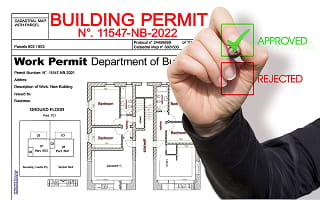
Permits are required for most construction, renovation, and home improvement projects in Grand Prairie. These permits are issued by the Grand Prairie Building Inspections Division. Exceptions may be made for cosmetic work like painting, flooring replacement, and cabinetry, as well as minor projects that do not affect a building's structure or core systems. You can apply for permits, submit plans, pay fees, and schedule inspections online through the city's Customer Self-Service (CSS) Portal (note: account registration is required for first-time users). In-person services are also available at the building inspections division's office, located at 300 West Main St., Grand Prairie, TX 75050, and you can call (972) 237-8230 or email information@gptx.org for general information and assistance.
Common permit types issued in Grand Prairie include:
-
Building Permits: Required for new construction and renovating, remodeling, or altering existing structures.
-
Residential Building Permits: Issued for work on single-family or multi-family homes.
-
Commercial Building Permits: Issued for work on commercial properties.
-
-
Electrical Permits: For installation, modification, or repair of electrical wiring, panels, circuits, or systems.
-
Plumbing Permits: For work involving water lines, sewer lines, gas piping, fixtures, or plumbing system changes.
-
Mechanical/HVAC Permits: For installation or replacement of heating, ventilation, and air-conditioning equipment or ductwork.
When applying for any of these permits, you must submit the proper documentation (building plans, blueprints, contractor licenses, materials lists, etc.). You must also pay the appropriate fee.
Building inspections are part of the permit process, and they ensure that the work complies with local building and safety codes. You can schedule an inspection through the online portal or in person at the office during regular business hours.
Real Estate in the City of Grand Prairie

Positioned between Dallas and Fort Worth, Grand Prairie is a principal city in the DFW Metroplex and ranks among the state's top 20 largest cities. Its central location and proximity to key air and highway transportation infrastructure make it a well-established distribution hub in North Texas. The city also offers a variety of attractions, including Lone Star Park, EpicCentral, Texas Trust CU Theatre, Louis Tussaud's Palace of Wax, and Traders Village, one of the largest flea markets in Texas.
Grand Prairie, Texas, has a population of 196,100 residents. The city has 71,787 housing units; approximately 96% of these units are occupied and 54% owner-occupied. It offers a wide range of housing options, including single-family homes, townhomes, luxury apartments and condos, master-planned communities, and manufactured/mobile homes, with common housing styles like Traditional, Ranch, Modern Farmhouse, Contemporary, Mid-Century, and Mediterranean. The average home value in Grand Prairie, TX, is $308,416, representing a 3.6% decrease from previous years. Note that actual values can vary considerably depending on the area in the city. Here are some examples of home prices in different Grand Prairie neighborhoods:
- Amesbury Estates $368,694
- Cimmaron Estates $350,593
- Coronado Forest $501,320
- Kirby Creek Village $293,524
- Oak Hollow-Sheffield Village $294,627
- Westchester Creek $336,268
The Grand Prairie, Texas, real estate market is a stable, moderately competitive, and slightly buyer-leaning market, supported by steady demand, ongoing development, and relative affordability within the DFW metroplex. Homes typically go under contract in around 34 days of listing, and about 20.5% of listed homes sell above the listing price.
Searching across multiple government offices and databases to piece together a complete property profile can be time-consuming, but PropertyChecker simplifies the process by pulling key ownership details, tax records, transaction histories, and more into a single, easy-to-use platform. Whether you are buying, investing, or simply doing your due diligence, visit PropertyChecker.com to get the property information you need in minutes.